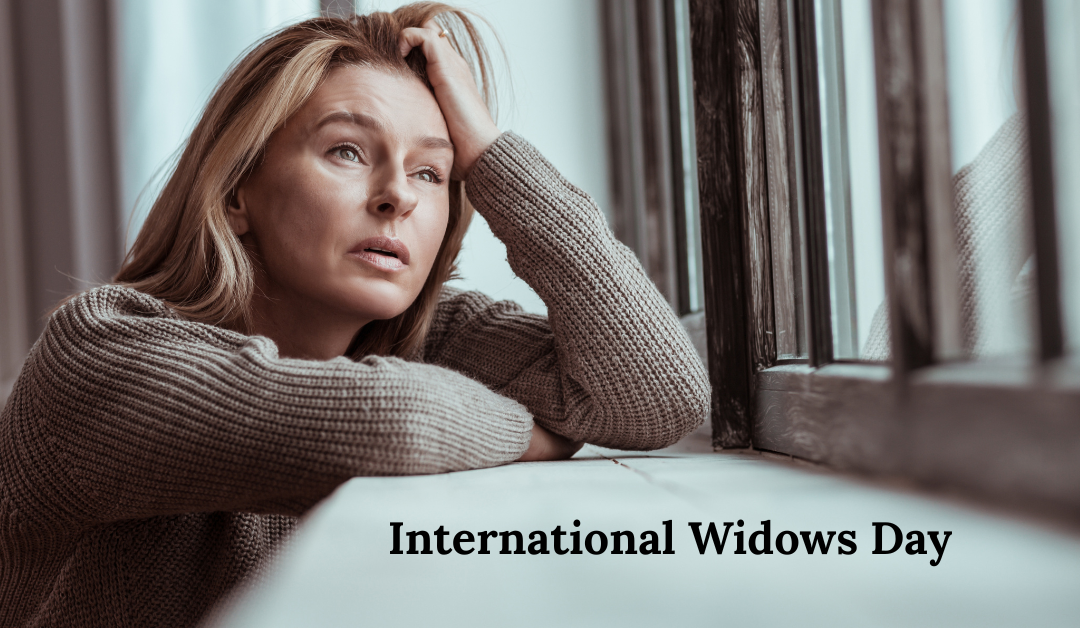
What an interesting question! One hears the word “widow” and there is a picture that comes to mind. An older woman, with white hair, known in the neighbourhood for baking cookies, who has lost her husband of many years. And yet, this word, with so many connotations is now being used to describe you. How can that be?
There is a myriad of emotions that arise with hearing the word “widow.” How does one describe that very moment when your identity changes from “wife” to “widow?” From “partner” to “solo?” From husband to “widower?”
Every widow will have their own experience, and their own set of emotions around all that has occurred for them. In my case, I became a widow at 39 years old, when my husband was killed in a car accident. As I was injured in the accident as well, I was given the news of my husband’s death while lying in a hospital bed. Due to my injuries, my eyesight was somewhat diminished and at that moment, I was in a haze. Things around me were quite unreal. My first thought I had upon hearing the news was, “OH!” The second thought was that I seemed to know this already, although that was not a formed thought. It is a moment I will not forget!
Widowhood is not a club limited to only women whose husbands have died. The term “widow” is more all-encompassing term that can mean a man whose wife has died, a woman whose husband has died, or a person whose partner has died. When we look at the differing situations, while there are individual issues for each situation, the losses are very similar – a most important loved one has died. And it is hard and sad and awful to have to experience.
In much of the world, becoming a widow is a terrifying prospect. There may be ostracism, denial of property rights, enforced remarriage for personal or financial safety, or lack of appropriate health care unavailable without a husband. Even in first world countries such as Canada, circumstances may arise with widowhood that can bring about financial insecurity, housing difficulties, and ostracism within individual cultures.
Surprisingly, I found there were situations where I was no longer invited, because my presence might make people sad. Or I was no longer part of a couple, so my being at a dinner might change the numbers. While these are minor difficulties, and no one would readily admit to thinking that way, there was that sense of discomfort for the host.
Today, June 23rd, is International Widow’s Day, a day to honour all widows, worldwide. The UN General Assembly adopted this date in 2010, after five years of lobbying by The Loomba Foundation, a charity based in the UK. The declaration of today as a day to honour widows will hopefully bring the many difficulties faced by widows to the greater attention of governments around the world.
Lord Raj Loomba, the founder of the charity, chose today’s date, as it was the day in 1954 that his mother became a widow. The Loomba Foundation has worked for many years to bring attention to the many and varied struggles widows around the world may face, particularly in third world countries. I was privileged to meet Lord Loomba at the United Nations in 2008, while he was doing the work of lobbying the General Assembly to declare this day one to honour all widows. In the few moments I spoke with him, I recognized a kind and caring man, one who also had a strong goal to accomplish.
So, back to the original question. What does it feel like to be a widow, especially here in Canada? We are fortunate to have many supports in place to assist with financial and social difficulties. This does not necessarily mean that things are perfect, of course.
It feels weird to become a widow.
I am still stunned. When I became a widow those many years ago, one minute, I was a wife, and the next minute, I was a widow. The surreal nature of this change is one that has stayed with me all these years. The person who was my partner in everything was gone. He was the one with whom I had chosen to spend the rest of my life. And in reality, whether your person dies suddenly, or of a terribly difficult and long illness, they are here one moment and gone the next.
That instant change of identity, whether one knows it will come soon, or it is a sudden loss, takes some processing to be able to fully realize what has happened. And, even then, does one ever fully realize the implications of an announcement like that?
It feels lonely to be a widow.
At that moment, that fateful moment, you feel completely alone. Your person is gone. They are not available to talk over this latest development in your life together. And now you have to figure out how to do life without your person, which can feel very lonely.
There were approximately 2 million people in Canada in 2025 who would be considered widowed. Even with this large number of widows in Canada, there is a good chance that there are not many widows in your life to whom you can turn for advice. I was very fortunate to have a woman in my life who, sadly, had lost her husband when her children were young. She was a kind and helpful presence, to whom I turned for advice occasionally. I am very thankful for her presence in my life at that point in my life.
It feels heavy to be a widow.
Suddenly, you are the sole responsibility for it all. Whether it be the children, the house, a family business, the relatives, the best friends, you are “it.” Of course, you will manage it all and do a fine job in the process, but the thought of not being able to share these responsibilities, of not having them to talk it all over with, can be daunting at times.
It can also be heavy to realize those wonderful plans you and your person had concocted, talked over in the wee small hours, would never come to fruition now. The dream house or the special trip celebrating a momentous anniversary or even watching the youngest as they walked across a stage or down an aisle. These events might still happen, but you will not be able to be together to celebrate them. That is heavy, and hard.
So how might it feel to be a widow? Weird, lonely and heavy, to say the least. These are difficult things to carry, no matter how the widowhood came about. And yet, most widows I speak with have moved forward with their lives. Life does continue, although at that very awful moment, it certainly feels like the world has stopped. There are the wonderful moments in that life that has continued. While celebrating those wonderful moments, smiling and being joyful, often a sense of the bittersweet is felt. We wish our person was here, to celebrate, to enjoy together, to look at each other over the collected loved ones’ heads and acknowledge each other’s happiness. And, after the event is over, to sip a cup of tea together and chat over the day.
Milk and one sugar please, he would have said.